Saturday, November 9, 2019

TMDM, Pt 2: What's Wrong with the d20?


This seems to be the week where everyone is venting their unpopular opinons about D&D, so what better time is there to dive into the heart of my search for a new die mechanic and talk about all that is wrong with the d20 roll?

Enlighten me oh blogger! What is wrong with the d20 roll?

Nothing actually. If it works it works. The d20 roll is tried and true and accepted by millions as the standard for role playing games.

  • You roll 1d20.
  • If it’s not an obvious fail you add a bunch of modifiers.
  • Think about it, add in a bunch of other modifiers.
  • Eventually call it quits with the modification and present a total.
  • If greater than or equal to the number you need to beat you succeed, otherwise you fail.

What’s wrong with that? Nothing could be simpler!

Designing a dice mechanic is a bit like designing a vehicle. It’s hard to screw it up. Four wheels and a platform gets you a go-kart. It will send a kid flying down a hill screaming with joy and/or fear, but it is nothing anyone wants to drive to work in. Making a dice mechanic better is the hard part. Creating something that takes people where they want to go, as quickly and efficiently as possible, but with a ride so comfortable they barely notice they are in a car? That is the challenge at hand! Of course, to face such a challenge we need to take a shrewd look at the d20 roll and see where it could use some improvement.

(Cup holders. It needs more cup holders.)

TOO MANY NUMBER RANGES
This is one of the most insidious of problems because once you get over it you stop noticing it. You forget about your own struggles to learn the game and start to wonder why others cannot see something which to you now seems so obvious.

Consider this - in D&D - how good is a 10?

As an ability score it is completely average.
As an ability modifier it is off the charts.
As a difficulty class it is pretty easy.
With ascending armor class it is so-so.
With descending armor class you are standing naked on the battlefield.
With hit points? _Nobody really knows._ In a game like B/X D&D you are a competent fighter. In D&D 5e you are a total push-over.

And now explain all of this to someone who has never played the game. Toss in a bunch of strange looking dice which have no consistent scheme of use as well as a slew of tables to consult while playing and….

Simple right?

A number by itself is meaningless. It needs something to measure and those measurements need to follow a predictable method of incrementation. Is a 2 twice as important as a 1 or is it just a nudge in the right direction? Is a 2 the right direction? Or is this one of those times where it is better to roll low than high? Multiple inconsistent number systems are a serious barrier to entry when it comes to recruiting new players. The fewer a game uses the better.


D20 IS NOT VERY REALISTIC
A perfectly average character with an ability score of 10 and a 1st level +2 proficiency bonus will only succeed at what they are doing 60% of the time. Imagine hiring a plumber who only fixes your busted pipes 60% of the time. Or a dentist who sends you home with a throbbing toothache 40% of the time. Or that guy you hired to mow the lawn finishing about 60% of it before failing somehow.

(I mowed a 1!)

Maybe it happens, but most people when they set about performing a task do not simply pass or fail. They perform at a fairly consistent level of ability. Occasionally, luck will have them doing a bit better or worse but for the most part they do what they can do and hope it fits the bill. Failure happens when the goal they are striving for hangs too far out of reach. At that point they could try harder to make it work but that isn’t what the d20 roll is about, now is it? Actually, can you name a system where a character can simply “try harder” to make it work? Hmmm. A glaring oversight there. Somebody ought to do something about that.

So anyways. What does the d20 roll represent?

We don’t know.

Like the hit point, it is one of those things most people would rather not discuss. Rolling the dice is just something you do in a game. The best guess is that the d20 roll represents random chance and all the unseen influences at work which could sway an outcome one way or another. If true then it has a problem because not everything your characters will do in a game will come with the same amount of random elements.


D20 DOESN’T ARM WRESTLE VERY WELL
I have two dwarven characters, Ralph Cabbagehammer and Grudge Orcslayer, who have been arm wrestling each other to test out dice mechanics since the late 1990’s. Don’t tell them, but they both have the equivalent of Strength 14 making them evenly matched in the muscle department. They kind of suspect this to be true, but characters can't see their own stats and so they keep arm wrestling each other.

The thing about arm-wrestling is that unlike normal combat there are few to no random elements involved. How do we test it with a d20 roll? The correct answer is - we don’t - not with arm wrestling. You compare strength scores and whoever has the greater score wins it (yawn). In the case of Ralph vs Grudge every match ends with a tie. They could arm wrestle for hours on end and never get close to slamming a fist to the table. Use the d20 to settle the matter the exact opposite happens. Ties become rare and the outcomes wildly unpredictable.

Maybe that’s not the worst thing in the world, but what if our two characters were not so evenly matched? What if Ralph’s strength suddenly dropped to 3 and Grudge’s strength amped up to 18. There should be no contest. Grudge should beat Ralph every time. Yet, according to standard d20 rules, Grudge with his 18 would gain a +4 to his roll while Ralph with his 3 would suffer a -4. Grudge would still win most of the matches but not all of them.

Ralph rolls 16 and Grudge rolls 6? Ralph wins!
Ralph rolls 18 and Grudge rolls 9? Ralph wins!
Ralph rolls 20 and Grudge rolls 11? Ralph wins!

(Probably not how Over The Top was meant to end.)

This is what people mean when they talk about the d20 being swingy. That randomness makes it untrustworthy and hard to plan around. A case could be made that random is random. D&D is a fantasy game. It shouldn’t be realistic. Yes, but RPGs are powered by the imagination and despite its penchant for unicorns and rainbows the imagination did not evolve to keep us amused while waiting in check-out lines. The imagination exists to help keep us alive against all the terrible possibilities of reality. That is its primary concern. That is the reason why so much of entertainment is centered around characters experiencing the absolute worst that could possibly happen.

The imagination is only interested in fantasy insofar as fantasy can challenge us with a more intense reality than everyday reality. A fantastic reality still needs a foundation of real reality to stand on. Without it a game will become plagued by doubt, leaving people thinking, “Yeah, that’s what the rules say, but if it were real that's not how it would play out.” And nothing sucks the interest out of an RPG quite like that.


GRATIFICATION NEEDS TO BE INSTANT AND PHYSICAL
This is part of being human. Physical actions are rife with importance. If you look at a role playing game with the sound turned off, what do you see? A bunch of people sitting around a table, chatting it up, occasionally scribbling notes on paper, maybe moving some minis. The one notable physical action involved is a roll of the dice.

This could be why diceless role-playing never caught on. On the lower end of the brain stem, rolling the dice is that thing that you do, that material assertion of your mojo into the unfolding story. Yet the d20 roll does not happen at the culmination of an action. It happens at the beginning. You do not roll the dice, look at what it gives you and instantly know how well you did. Instead, the die is rolled and a lot of jibber-jabber follows. You add modifiers to the roll, compare it to another number, modify that number, remember some other modifier which should have been added in but weren’t (can’t we add it in? Pleeeese?). If we ever get to the end of this, the totals are judged and then we figure out what actually happened.

I think this is why people like rolling for damage as much as they do. While it does slow a game down a bit, rolling for damage gives players something physical and immediate to end their action on. It helps bookend the action, giving us two solid points to know where it all begins and ends. Of course, you are not always rolling for damage every time you roll the dice, and there is nothing more disappointing that a terrific hit roll that ends with a roll of 1 on the damage die.

Not to beat a dead horse to bursting, but this could also be the reason why people love the idea of critical rolls happening on a 20 or 1. It pushes all the math aside and as soon as you see one of these numbers turn up the dice tell you that something interesting and unexpected is about to happen. Wouldn’t it be great if all the numbers on the dice worked that way?
Hmmm….


D20 ONLY ROLLS ONE DIE
This last one is more subjective if not downright superstitious than the rest, yet it is no less daunting a force to consider.

The roll of a single die feels weak.

We have a long history of divining the will of the gods through random things: drawing Tarot cards, reading tea leaves, cutting the head off a chicken and looking at the blood it splatters as it does its final dance (not recommended for RPG’s btw), but presumably no divination technique has been with us longer than the rolling of bones, the casting of lots, the reading of runes. Call it what you want but cleromancy - divination by way of dice - has been with us longer than civilization itself. Some of its superstitions are so deeply ingrained in the collective psyche that we naturally heed them without even realizing that we know them.

Blame it on the cajones, but a perfect roll of the dice is a two die roll. Three dice is acceptable. Four dice is passable. Five or more is just a mess. But a single die roll is unforgivable. Dice need to make a sound when they roll. We need to hear them clatter in our hands before they hit the table. This wakes them up to our presence. We also need to roll our own dice for ourselves. In Original D&D only the DM was supposed to roll the dice. The DM was essentially a game console you fed commands to and it returned the results of. All number juggling was hidden under the hood / behind the screen. This method was quickly dropped and never explained, but I believe it had something to do with people being irked by an inability to roll their dice for themselves. As if we actually have some kind of control over the numbers that turn up.

Maybe we do. Out loud we have to admit that chance is purely random. The dice produce numbers with utter indifference to our needs, just like the random number generation machines that they are.

And yet….

In the quiet of our minds, slithering down around that brain stem we know that there exists a greater truth. The dice are an extension of our bodies. It’s our touch which causes them to roll more often in our favor than not. It is God or the Gods working through us which causes the dice to roll what they roll.

(But he does love to mess with those who do.)

Look at the game of Craps sometime. The amount of superstition which surrounds it is astounding. An RPG is not a game of craps with characters, but it does primarily use dice and dice come with rules of their own which might as well be etched in stone. One of the biggest being that you never roll just one die by itself.


AND THAT’S IT
I’m sure I could dig up more, but the point wasn’t to condemn the d20 roll but to figure out what needs fixing. In short…

  • Limit the number of number ranges the game uses, and make sure their patterns do not conflict with each other.
  • Make action resolution better resemble reality, even though we are dealing with fantasy.
  • Turn the die roll into the dramatic end point of an action, or at least do a better job book-ending the action between two related die rolls.
  • Roll more than just one die.

And that is what is coming up next with a look at the Risk Roll. My first attempt at creating something better than the d20, crafted so many years ago.

Sunday, November 3, 2019

A Tale of Way Too Many Dice Mechanics, Pt 1


Normally I make New Years Resolutions and drop them by February just like everyone else. This year I’ve decided to do something different. I have made a resolution I want to finish before New Years instead of after it. By Jan 1st 2020 I will have finished the rules of the Agama, and released a working prototype of the game.

What is the Agama?

Funny you should ask…

The Agama is the latest and hopefully - last - incarnation of something I have been tinkering with since the day I came back from Gencon ‘93. I had just graduated college and spent most of the summer sending out job applications. Thanks to a recession I was also getting nothing in reply. Some old friends from high school had decided to go to Gencon. They said they thought about inviting me but knew I was also busy looking for work and probably wouldn't be interested. Then someone dropped out at the last minute, a seat in the car opened up and (possibly even more importantly) they needed another person to help split the hotel room bill. After chewing them out for not giving me any time to register for any events, I said what the hell. I needed a break and a road trip did qualify.

Despite going to Gencon and not playing a single game, it did prove to be  a fun trip. I wandered the convention hall. I made friends with a cute girl who was stuck waiting in the hall while her boyfriend played games. We went to the Milwaukee Museum of Modern Art and made fun of the exhibits.


(A bit like this but with less punk, less rock and more Milwaukee.)

I also looked at the state of gaming. DOOM had just recently exploded onto the scene and the wargamers among us were going nuts over first-person shooters. Meanwhile, the drama majors had abandoned the tabletop for LARPing and were going gaga over White Wolf games. What did D&D have? TSR was trying way too hard to build up scant interest in DragonStrike a VHS powered fantasy adventure game that people were stopping by the booth to laugh at, not with. There is a difference.

(Or is it a crime against humanity?)

TSR had finally and irrevocably lost touch with one the best things about the tabletop RPG and that is the ability of its players to imagine the game as they wanted to see it. With Dragonstrike it felt as if someone in the corporate board room had read the latest spreadsheet, looked at what they were producing and decided that D&D was suffering from a failure of imagination on the part of its players. Their problems had nothing to do with the game itself. THAC0 was a perfectly fine concept that anyone could grasp. It had to be the players not seeing things correctly.

Anyways. The weekend ended. We all returned home. I went to the bookshelf in my room, noticed how my gaming books had been collecting dust and had to wonder - why was it failing? - why was something which once held our rapt attention now just barely grabbing us?

The obvious answer was that times had changed. Computer games had grown too good. The internet was spreading across the world and blowing people’s minds with its infinite (albeit dial-up speed) possibilities. But that was nothing I could do anything about. I started to wonder about the game systems. AD&D in particular was a game we loved but almost hated to play because of how often the game would melt down over some dispute over the rules. I started to wonder what could be done differently. What could be changed to make things better. Because of my group’s many problems with the rules, house-rules had come to be abhorred, yet since we had also moved on to other things I figured no one would care if I dissected the games we loved and cobbled together something made from their best parts. The tabletop rpg was dead wasn't it? Nobody would be playing these things in a world with DOOM in it. Come on. Who are you kidding....

Without even knowing a word for it existed, my first game was a Frankensteiner based on Gamma World and set in our home town a few hundred years after the fact. It wasn’t bad. It almost even got played, but that’s a story for another time.

Although my game design failed, through it I caught the design bug. By the mid-90’s I had created a stand-alone system called Theater of the Absurd. It was essentially a way of playing Pacesetter CHILL but with better mechanics. Or at least, what I had hoped would be better mechanics, the name partially referred to just how weird and wonky everything turned out to be. This would later be shortened to the ToAd, because it was kind of ugly and covered in warts, but it could take you to amazing places if you dared lick it. What no takers? The ToAd was also more of a universal GURPS-like system that could be used with anything. Just as soon as I brought one of those anythings into existence.

(Not our actual mascot but you get the idea)

Around 2000 the ToAd was re-invented yet again to become Tales of Adventure. I had learned website programming and for a while hosted a fairly popular website where you could create and store characters and equipment and pretty much everything including your own worlds. Suck it D&D Beyond! The ToAd was there first. Unfortunately the web technology of the day was a pretty crude affair and using the site proved to be far more work than it was worth. A few years later I demolished it and rebuilt both the game and the website from scratch to create the Model Reality Kit or MRK.

Then 2008 hit. Things got crazy and I pulled the plug on the MRK. I also came to the realization that trying to build a support website for a game that was still in development was like trying to frost a cake before baking it. The website idea was chucked and the next few games would all be on paper starting with an OSR inspired return to fantasy adventure called the Komodo. Because it’s a dragon. A real dragon.

(Get it? Get it?)

Well. It doesn’t matter. The Komodo morphed into the Komo Dosr and I simply didn’t like it. It wasn’t just a return to the games of the past but also a return of all their problems. I pushed it aside to work on something totally different, something light and fast called the Red EFT. It was fun but it was so outside of what I knew, I wasn't sure if I trusted it as the foundation I was looking for. I returned to the Komo Dosr, broke it down and rebuilt it from scratch to create the Agama. Which is where I’m at now.

(Have you noticed a pattern yet? A borderline fetish?)

So what took so long?

Game design, I learned, is a lot like playing Jenga. It’s not enough to stack up a bird’s nest of rules. You also need to carefully remove as much from it as possible without knocking the whole thing over. To some degree it is harder than Jenga, because once you have reached that point of perfect lightness you need to start stacking books of stuff on top of it - representing the imaginary world itself - and hope that it all holds together. The perfect game system is like a geodesic dome. The concept is simple and it can be built using ordinary items, but by a trick of geometry the dome is also strong enough to withstand a hurricane.

I just could never get the foundation right. Every time I poured the concrete it would crack as I discovered something new that would work better or faster or more imaginatively. Eventually that innovation would push me to the point of ditching everything and starting over from scratch.

And here I am again. The Agama is mostly written. What is keeping it from being completed is an inability to decide on its die mechanic, that all-important kernel of any RPG system. Currently, I have too many choices and no desire to throw it away and start over from scratch. Like Danny Glover in the Lethal Weapon movies I’m getting too old for this shit.

So with this series I’ve decided to do an in-depth analysis of the primary contenders, pick one and try to be happy with it. Who knows, maybe by New Years the conundrum will be solved and I will have actually finished something. Which ironically is what most people would consider the starting line of game design.

(YEEEEEE-HA!)

So consider this the start of a bunch of related blog posts looking back on my favorite die mechanics from the last few years. Not all of them, just the good ones.

What’s up next? First a look at the venerable d20 roll and whether or not it actually needs to be replaced. Stay tuned....

Wednesday, October 30, 2019

CHILL Art!

I hate to say it but it seems as if RPGs these days are chock full of art which is technically astute but as sharp as a wad of old chewing gum. Flip through the 5e D&D Players Handbook and it is character in armor, character in armor swinging weapon, characters in armor sitting around a campfire half of them apparently asleep, character in armor, scattering of tools, butterfly, spider, encephalitic halfling playing a lute that is thankfully mute, character in armor, character in armor, wizard casting spell of some sort, character in armor.

Ugh. Snore. Yerk! (Sound of my head suddenly jerking awake)

That is some damn dull art. Sadly, it almost seems to prove my suspicion that art in RPGs is like grammar. It is something that needs to be there to prove that someone cares about what we are reading. On the whole, after the initial purchase we stop noticing it. The art becomes a layout device to break up text walls and does not much else.

Since Halloween is almost upon us, I thought I might take a look at a game which I think does have good if not great art in it, and that is the original CHILL from Pacesetter which came out back when I was a kid circa '84.

CHILL has been and still is a spotty affair. It had great creative writing, crappy mechanics, and a slew of follow up editions that should never have been made. I'm sorry if that trods on any toes but Mayfair Chill looks like someone pulled it out of a dumpster dive and 3rd Edition, while doing much to improve the rules is just a strikingly dull affair. Sometimes it almost feels as if CHILL is a cursed property that no one can seem to do anything with. Or at least, nothing that improves over the original.

One of the reasons for this may have something to do with the excellent artwork of Jim Holloway. Most of it is done in stark black and white. It is not edgy. It is not extreme. It often looks like stills taken from a Hammer Horror film, but it is a whole lot of fun. This is what I mean about being sharp. A decent amount of thought was put into each of these images, probably well before pencil was ever put to paper. So let's take a look....


No snoozing around the campfire here. This guy is screwed! He is in a dark cemetery at night with at least two beasts to content with (probably werewolves, Pacesetter CHILL loves its werewolves). Oh yeah, and he has a single shot pistol. Is there a silver slug in that gun? Let's hope so.

Holloway loves to put a sense of direction and depth into his art. This one starts in the lower right corner of the foreground, shoots through it to the fearful expression on the guys face, and then goes beyond it to the red eyes he is blindly running towards. We are seeing this scene from the point of view of the creature which heightens the tension by implying that there is no guarantee mutton-chop man is going to survive the night.


GyaAAAAAAAAH!!!!! It's hard not to jump a bit when seeing this classic pic. This is no character in armor standing around waiting for something to happen. This is a guy in a suit who has probably fallen while fleeing a cemetery and hit the ground in the worst of all possible places. That arm is shooting up out of the ground, implied by the small bits of dirt hanging in the air around it. Once again we get a great use of perspective with the head stones adding to its depth. Holloway loves to use the moon as a back light, allowing him to highlight a face while still using a perfectly black sky.


"You Cowards!" You can almost hear her shout as the men in the room faint and flee around her. Once again, Holloway isn't interested in an unexpressed face and neither are we. It's also interesting that he doesn't care much for drawing furniture. He can, it shows up in other pics, but if the room is dark then why bother with anything but darkness? You can pretty much guess that there is a werewolf standing in the doorway but because all we are given is a silhouette we don't know for sure and that adds to the tension of the scene.


You never want to let the viewers eye fall on an image and go thud. This one has a great swoop of motion funneled through the big areas of black in its corners. The interest begins in the upper right hand corner, moves down over the werewolf, follows the creature's gaze in the direction of the girl moves up her dress, over her hands to her face and then follows the gnarled branch back onto the werewolf, or possibly off to somewhere else. Does he know she's there? Has she hidden herself well enough? Roll the dice...

Another great thing about this pic is its use of shadows. Hiding half of her head in darkness but showing us the whites of her eyes truly makes them pop.


Speaking of popping eyes, this is another great pic which has nothing over the top happening in it. The PC's are examining a skull that has been shot in the head. That magnifying glass blows the guy's eye way out of proportion. It says to Look! Look here! Look closely! There is something important to be found.

An interesting observation. Sherlock isn't looking at the bullet wound in the skull, the most obvious point of interest. He's looking at something else about it, possibly its teeth. What it is we will never know.


Be careful what you read in Chill. There is no telling what it might summon. In horror, you never want to show the entire creature. To know everything there is about a beast defines it, encapsulates it, limits it. Leaving it partially hidden erases its parameters. In the darkness there is no telling where its horror actually ends. But....

It's a werewolf. It's always a werewolf.


Want a great depiction of fear that doesn't involve chainsaws? Put Ben Franklin on a horse which is so spooked it is beyond control and running as fast as it can across the moonlit countryside. Ben is saying, "Whoa! Whoa! Nag Whoa!" but the horse knows better. It knows the headless horseman is charging up behind them, flaming jack-o-lantern in hand.


Once again, this is not just a picture of a thing. It is a happening. It's a big complicated messy misunderstanding just about to break. Isn't it great! So often adventurers get to run around doing whatever they want, but in CHILL the world still is as it is and for the police that five hundred year old vampire is just a kindly old, slightly eccentric, gentleman who is having his rights violated by a bunch of mutton-chop bearing hoodlums.


More fun with vampires. It's not enough to show us characters standing there. Everyone is doing something in this scene, even the vampire himself who we somehow know is summoning up the swarm of rats squeaking behind them. Another thing Holloway loves to do in his pictures is put a frame around the image and then break it (look for the torch and flying rat) to provide an extra sense of depth.

Is it me or does this one seem a lot like the raising of the flag at Iwo Jima? Either that or a deleted scene from The Breakfast Club. Speaking of eating....


Even by Florida standards, that is one hell of a roach. I love the guy about to chuck a squab at it. When was the last time someone in one of your games chucked a squab at something?

Once again, the picture is not just about having something happening but also capturing everyone's reactions to the happening. It makes one wonder, if something is happening and the characters are not reacting to it then does it actually happen at all?


Probably one of the most bad-ass images in all of classic gaming, nothing says Chill quite like a werewolf battling zombies in a decrepit old graveyard full of gnarled trees and with a big bloated moon hanging on the horizon in the background.

It makes me wonder about what else might be going on behind the scenes of all these pics. Could it be that the guy who fell in the cemetery before the up-shooting hand is actually a werewolf? Is the werewolf a villain or a hero? The world will never know.

With all of these works, it is also good to pay some attention to what is not in them. There is worry, fear, rage, concern and disgust, but there are none of the truly negative aspects of horror. No one is being tortured. No one is reduced to tears and begging for their lives. This is fun horror. Terrible things happen but no one's soul is ever being crushed beneath the heel of the bad guys. If anything, this is fight or flight horror. It brings out the best in these characters, forcing them to do more than they ever thought they could.


Ultimately, CHILL is an excuse to have characters run around screaming their heads off and occasionally hacking apart some ghoul with a shovel. Thanks Jim Holloway! There is just so much to love here. Happy Halloween!


Pop!

Saturday, October 19, 2019

Car Wars 6th Edition. Autoduel for Dummies?


JFK riveted a nation when he said, “We choose to go to the Moon in this decade and do the other things, not because they are easy, but because they are hard!”

And in not nearly as glorious a light, I think the same could be said about why we played Car Wars back in the 80’s. Or at least why we spent so much time designing cars for it. When you pulled together a Car Wars car you milled through hundreds of equipment options, balancing price, weight and space with your vehicle’s engine power and suspension and chassis limitations. You crunched numbers. Boy did you crunch numbers. I think I once broke a calculator crunching all those numbers. Strangely though, that is what made Car Wars fun.

Know what sucked?

The game itself.

The downside of Car Wars was that you would eventually have to play Car Wars, a game with slow  screwy rules played on an overly large map that used dinky little cardboard chits which skidded out of control when you breathed on them. The only reason to play Car Wars was to test your vehicle design and take it back to the drawing board after the game destroyed it. If my friends and I had all been born two decades earlier, we all probably would have been gearheads doing the same thing with actual hot rods which we would take out to the desert to drag race American Graffiti style.

Or possibly not. That kind of thing is expensive and we lived nowhere’s near a desert. Like everybody else we probably would have sat around dreaming of such things. Which is why we play games. For the time and money involved, Car Wars is a lot cheaper than the nearest reality.

So anyways….

I just caught this video review of the new Car Wars 6th Edition which is coming out sometime soon.


It’s Easy Guys! Come on, it’s so so Easy. So much easier. And a whole lot easier than it used to be. If I had a dime for every time they called the game easy, I’d be rich and SJGames would be broke.

They realllllllllllllllly want us to believe that the new Car Wars is easy.
The funny thing is that I’m not sure if I believe them.

I can’t say anything for certain because I haven’t seen the rules, but from what I was able to glean, the new game seems more abstract than the original but not necessarily easier. You roll dice with little symbols on them. Like a cash registers at McDonalds they try to use hieroglyphs in place of words wherever they can. I didn’t see anything which resembled a speed or handling track. Maybe this makes it all easier, but the problem with an abstraction is that you cannot use your imagination to reason your way through it. All you can do is roll the dice and take whatever it gives you.

What do you want to eat today? Roll a die….

1 Big Mac.
2 Quarter Pounder.
3 McRib.
4 Fillet-O-Fish.

A 3! Oh, don’t look so sad. A lot of people like the McRib, and it only comes out once a year. Please come again….

I like what they had to say about Funsics vs Physics, but original Car Wars never ran on physics to begin with. It was always a close approximation of what seemed to be real, done to impart a realistic quality more than anything else. Funsics seems to be more about, “we can’t give you reality so we’re just going to give you a load of barbeque sauce and hope you don’t notice what’s missing.”

(Contains as much pork as Car Wars contains Physics)

Meanwhile, building a vehicle has been dumbed down to where your vehicle has a number of Build Points (like 16 or 32) and everything you add to it will cost a number of points. No price/weight/space or acceleration calculations. It sounds like something pulled from a video game. It feels like the principal was to zip through vehicle design as quickly as possible, something hearkening back to 5th edition Car Wars which had no vehicle design rules and had reduced the game to a collection of over-priced pamphlets containing pre-made vehicles and rules which if I recall correctly were still not complete enough to let people actually play the game. If there was cash to be grabbed, 5th edition would have existed to do just that and not much else.

Now. I have nothing against simple games that are easy to play and Car Wars - more than any game out there - could use a complete rules overhaul when it comes to the play of the game?

It feels like it is missing the target, that something is being lost.

The entire gaming world seems to be racing towards a ephemeral state where games are designed to be picked up, played once and abandoned. Like getting tube socks in a plastic bag with a ziplock seal, you may actually wear the socks until they hatch holes, but the company itself would much rather have you treat them as lunch meat for your feet. Something you would never think to wear twice. And yet, this is Car Wars. You never played just one game. If anything, games like Car Wars and Battletech were more sports than games. There was always an element of “wait until next time!” as you wheel the wreckage of your latest creation back to the drawing board to make changes and tweak endlessly.

(better believe I'll be back)

So. 6th Edition is finally going to be a thing. It will probably be SJGames does Gaslands. After all, if it wasn’t for Gaslands pulling the rug out from under Car War’s former glory there would probably be no 6th edition. Will it be good? Will it suck? Well, it really can’t be any worse than Car Wars itself. The question is, will it still be Car Wars or will this be more like Twisted Metal the tabletop edition?

We’ll just have to check it out and see.

Saturday, August 4, 2018

The Adventurers Club

Want some old-school cred?
I gotchya old school cred right here…


This is from Dimensions ‘84 my Junior High School yearbook. I am the kid in the center shuffling a bunch of papers and notably - not - looking as if the entire party had just been TPK’d. Chris, the tall kid standing next to me, may have been the DM or it may have been me. We all took turns DM-ing different adventures. Honestly, I don’t remember the photograph even being taken. It was definitely staged though. One of us is probably standing so we didn’t have to sit with our back to the camera. We did push desks together to play on, but the surface usually wasn’t so cluttered. We probably did this for the photo because - D&D - even back then it did not seem right without wobbly towers of books and papers sliding around the table.

I also have no recollection of being voted “co-president” of the group. That was complete news to me when the yearbook came out. Maybe Joe Spoleti (not pictured) snuck it in there to get access to the dodgeball launch codes, or whatever it is that the co-presidents of after-school groups actually do. It says we were a club but we were really more of a group. Part of being able to use the school was an open door policy where anyone could join. There were no strange initiation rites. If you showed up we would set you up with a character and try to squeeze you into the game as best we could. Girls were invited but none dared to show, so it did remain something of a sausage fest.

(and maybe that was all for the better) 

Every Tuesday and Thursday (I’m pretty sure) we would meet after school in the social studies room and play for a couple of hours. Mrs. Dewsnap sat quietly at her desk in the front of the room correcting papers, undoubtedly listening in to make sure things didn’t get too out of hand. To her credit, she never intervened on any of our games, and to our credit things we never got so out of hand that she had to. We were good kids. We even had something of an unwritten policy where you never killed anything unless they had done something to deserve it, especially humanoids. In a strange way, I guess it’s kind of fitting that it all took place in the social studies room. Now if only actual human history could be so kind.

I moved to Red Hook in the summer of ‘82 and the Adventurers Club had already formed by then. I really had no idea what D&D was and had only heard of the game through news coverage of it being burned in effigy, but I needed to make new friends so why not? On the very first day of school I was invited to join. I became the party cleric (of course) and it was love at first die roll. I turned some skeletons with my holy symbol and never looked back. I don’t know what the Adventurers Club was like before 82, but I’m pretty sure it peaked around 83/84. Not many people had shown up for this photograph but I do recall games where we had like twelve kids all trying to play at once and getting absolutely nowhere. The idea that there could be a maximum number of players in a game hadn’t gotten around to us yet.

By 84/85 the group was on the wane and by the spring of 85 it was over. So my experience with the golden age of RPG’s perfectly fit into the stretch of Junior High and maybe that was the problem. We were eager to move into High School and become teenagers - cool in every way - D&D had not yet developed the stigmatism of being a nerdy pastime (that was the chess club, three rooms down the hall). Two of the guys in this photo were on the football team. In fact, we often had jocks playing with us if their favorite sport was out of season. Still, the things you do in Junior High just don’t fly when you get to the hallowed halls of High School, where the rule of cool is more autocratic law than mere guideline.

(Come to think of it, the Red Hook Junior High
 really does look a bit like a castle.)

Another problem may have lain in the games themselves. Specifically D&D, and that specious notion that when your character dies you have to start over at 1st level. No one wants to start over at first level when everyone else is 7th, 8th or 9th. Especially when most of your XP comes from creatures killed, and the way we played had all of the XP going to whoever delivered the killing blow. That was the way we played and we followed those rules a little too religiously. On the internet there is this notion going around that the Rules Lawyer did not exist until D&D 3.0 -  w  r  o  n  g  - oh so wrong. I think that for as long as there have been rules there have been rules lawyers looking to win on a complication. D&D exploded with content during these years. Between Dragon Magazine and Unearthed Arcana the rules bloat made playing the game nearly impossible. There were way too many instances of people stopping everything to look something up and then squabbling endlessly afterwards over what one thing or another actually meant. The idea of the DM being above the rules was another convention that was not a part of our mindset and our games truly suffered for it.

Far more insidious (more insidious that rule lawyers! Impossible!) I think the Satanic Panic also caught up with us and took its toll. There were a number of kids who truly loved the game but just stopped showing up for reasons they would not discuss. I am Catholic and the family did go to church every Sunday. In fact, I was actually a regular reader of the liturgy. But my parents were college educated and they knew hokum when they heard it. We never had that little talk about the perils of Satan & D&D. If anything, I think my dad got a kick out of the fact that I enjoyed something which in many ways resembled the school board meetings his job forced him to attend. He probably wished his meetings could have been as much fun. Yet, I do remember that at the end of Confirmation we were given a meeting with our priest and allowed to ask him anything off the record. The one question which commanded the whole affair was, “what’s wrong with D&D?”

And it was not asked by me.

I was largely a silent observer. It was brought up and debated by those kids who were in the AC but had mysteriously dropped out. I actually felt bad for Father Coen because they had him pinned to the blackboard with something he honestly knew nothing about. There were actually many reasons to condemn D&D at that point, most notably the idea that you had to kill and steal to get ahead, but the best he could manage was the tired old line of “it involves, witchcraft and demons and magic and things you should not be playing with” which all boils down to “you don’t play the game because my higher-ups are telling me to tell you not to play the game.”

We may have been confirmed that day, but it was an indoctrination into a world where you say what you say to toe the line yet rarely ever say what is on your mind. Welcome to adulthood kids. I suspect the church lost some converts that day and the free thinkers of the world gained a few. Or at least, so I hope.

Last but not least, there was also the rise of the VCR and girls and after-school jobs and cars. And actually a whole bunch of other adultish things to drag us away. As John Cougar Mellancamp sang it best, hold onto sixteen as long as you can ‘cause changes came around real soon to make us women and men.


But for everything that went wrong during this period it was still dramatically outshined by all that we got right. The camaraderie, the friendship, the astounding feats of imagination. Gaming wasn’t pure escapism. It wasn’t any one of us alone, dreamily disappearing into the pages of a novel. When we joined forces on those Tuesday afternoons it felt like we were actually accomplishing something. We took our games seriously - sometimes a little too seriously - but we came out of them feeling bold, noble, mighty, proud.


And I wouldn’t trade that for anything.

Sunday, July 29, 2018

Junk'd is not Junk!

GO BUY THIS GAME. For no better reason than to keep Hankerin cranking out the beautiful craziness which is Runehammer games. Junk’d costs about as much as a gallon of gas and will probably give you far better mileage than whatever car crash game you may to be playing right now.

For the record, I have not played Junk’d. All I’ve done is read the rules and dreamt about it a bit. But I have seen enough to feel confident in saying that the writing is excellent. The art is spot on. The game is fun. And I absolutely love the idea behind the Ghostriders. It gives those players who are no longer in the race something to do besides sit around and wait to see who wins it. It also goes to show just how well thought out the game actually is.

(And is just wicked fricken cool!!!!!)

Junk’d easily circumvents one of the biggest problems with tabletop driving games which is the matter of accurately portraying vehicles designed to cover long distances in a short stint of time.

It simply doesn’t.

And that’s a good thing.

Instead it goes for the abstract, the engine power of your car does matter but it works in fits and spurts, only periodically moving you forward. Twelve steps forward and that’s a battle. Unlike Car Wars, you don’t need a free ping pong table to play on. Using micro machines you might even be able to play Junk’d in the back seat of an actual car. Think about that for your next road trip.


(Hey you kids! Keep it down back there!
Don't make me pull over!)

Vehicle design is super simple. It can be done in under a minute. And yet it still has a feeling of importance. The vehicle you drive will change the way you play the game. Maybe Junk’d doesn’t have enough meat on the bone to satiate any serious gearhead urgings, but at least you won't spend a whole evening beating a calculator to death to make one car.

Where does Junk’d falter?

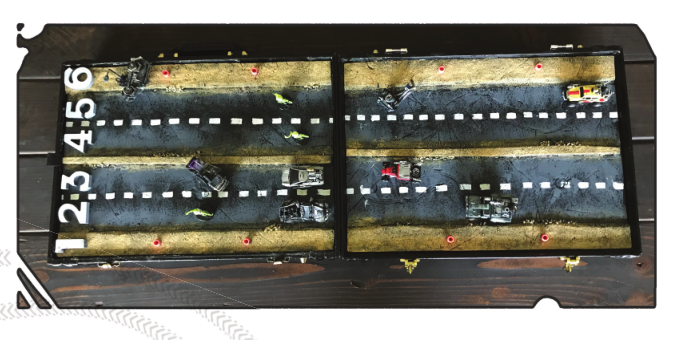
When I said the writing was excellent, I meant the creative side. The instructional side is a bit iffy and even after reading it three or four times I’m still not completely sure I understand how the game is played. It is a turn based game and on each turn you make one of five dice pool rolls.

Engine - for moving ahead and powering to the end of the stretch.

Tires - for swerving side to side, changing lanes.

Ram - for slamming sideways into a vehicle beside you.

Guns - for taking a pot shot at someone directly in front of you.

Armor - for surviving being hit by gun fire or a collision.


Actually, you choose one of the first four. I don’t think there is ever a reason you would voluntarily roll your Armor. With engine you move straight ahead as many segments as the best number rolled. With Tires, Ram and Guns it is good to understand that there are six lanes on the stretch and each are numbered. With Tires you may move into any lane you rolled the number of. With Ram you do the same but only if there is a vehicle there for you to hit (where that vehicle goes after you slam it is not so clear, maybe you ride on top of it?). With Guns you can shoot someone directly ahead of you, but only if you manage to roll that lane number.

Now, Tires I like, even if it leaves you in the awkward position of being unable to switch into the next lane over but able to careen all the way across the board. Yes, your steering wheel is made of silly putty.

Guns is alright, but I think you should be able to target anyone on the stretch of road just as long as you are able to roll the number of the lane they are in. Having to move into a lane and roll that lane’s number feels like a bit much.

Ram is the only roll that doesn’t sit well with me. Sure, it is basically a sideways version of the Guns roll, but it is a little too abstract. If anything, I think Ram should be like Armor, a defensive roll you need to roll a 6 on whenever you collide with something. Hit a wreckage, roll a 6 and you burst through it in a cloud of bent flying steel. Engine forward or tires sideways into another vehicle and both drivers need to make a Ram roll. Whoever rolls the lesser number gets junk’d (a tie junks you both!). Beat the other vehicle’s ram roll and that vehicle also get pushed backwards a segment to make room for you.


But that’s just me.

When it comes to games I’m like the Mikey the Life cereal kid. I’ll waste anyone who tries to come between me and my milk-soggy bowl of corn puffs.

On the whole. Junk’d is an excellent little car battle game that should hold the world over until another Mad Max movie gets made. It does not accurately simulate anything, other than the abject insanity of a Fury Road drag race.

And when the hell is another Mad Max movie coming out! Star Wars films keep dropping from the sky like so many malfunctioning satellites, and yet Fury Road 2? Come on Mr. Miller, hit the nitro already.

Dammit, where are my dice!

Saturday, June 23, 2018

Kull the DM!

So, this past week I got in a conversation online about whether or not RPGs could exist before the 1970’s. I mentioned a fragment of writing by RE Howard which appears to have some of his characters sitting around a parlor and playing one. Thaddeus Moore wanted to know where it could be found so here it is. It comes from the back pages of Kull Vol.2 by Baen Books.


But I thought I would do Thaddeus one better by scanning in the pages, so here they are. The parts which I found most interesting at least. The rest of the fragment is just two more pages describing the history and appearance of Howard’s characters.


Yes, it is not much to go on, but there are some interesting points to be found here. Kull shouts out Score! So the imaginary game does have a win condition and is being played competitively. He moves an ivory figure which insinuates a game of fantasy chess. He tells Brule “my wizard menaces your warrior” which could be taken as “my bishop moves to where it could strike your knight” but why would you tell your opponent this? And when was the last time you played chess with three people? Ronaro doesn’t make a move in the game, but he is sitting at the table and described as one of its players.

Probably the most interesting bit is what Brule says on page 192. “A wizard is a hard man to beat, Kull, in this game or in the real game of battle-” Granted it was probably meant to be nothing more than a segue to Brule telling a story, but it does imply that you do not simply defeat a character in this game by knocking them over like a chess piece. That there might be some hit points involved, some special powers and the casting of spells.

If only Howard had written something about rolling dice!

My point is that the dream of the Fantasy RPG was there. I suspect that RE Howard while writing this bit of text wasn’t just thinking about a possible story but also about how cool it would be to have a game where he and his friends could play the characters in his fiction. Maybe that’s why this fragment never went on to become a full fledged story. When you’re writing, it’s easy to get derailed by a good idea.

The 1930’s would have been perfect for the advent of the TTRPG. Print technology was at its prime with only film and radio to compete with. Polyhedral dice did not exist but six-sided dice were plentiful. And of course, there was the depression. There would have been large numbers of people in desperate need of a cheap escape and stuck with more than enough time to play in a seemingly endless campaign. It’s easy to imagine Weird Tales printing a single issue containing nothing but the rules for an RPG written by its authors - providing anyone ever thought to do so.

And that’s the clincher.

Ultimately, my answer to it all was -No- at least here in the USA the TTRPG could not have existed before the 1970’s, the reason being that you need the tumultous revolutionary thinking of the 1960’s to open people’s minds to where the playing this game - which comes in a box but has no board, a game with no winning condition, a game where you play with your friends rather than against them, a game where you and your friends pretend to be elves - is possible. Even in Howard’s imagination he cannot totally escape the idea of games which have an end and a winner and a competitive nature. It’s easy to forget just how rigid people's mindsets were in the 40’s and 50’s and presumably every decade leading up to the 1960's. In the 1950’s, when Elvis was caught shaking his hips on the Ed Sullivan show the world exploded with moral outrage. This is not a world which is ready for Dungeons & Dragons.

Even back in the 1930’s, if I remember right, pulp magazines were treated like pornography. They were kept under the counter at the local drug store, meaning you had to ask for them by name and endure the disapproving stink eye of whatever American Gothic caricature happened to be working the counter that day. So even if Weird Tales had produced an RPG it would have never encountered the massive success which D&D did in the late 70’s and early 80’s. It would have been frowned upon into oblivion. Just like the weird pulp fiction of Howard’s time, it would have become a niche hobby enjoyed by scattered bunches of basement dwelling weirdos.

(Not that there is anything wrong with that.)

In my comment to the post I also joked that you had to be stoned to enjoy a game like D&D. I did not mean this literally. Marijuana & Dungeons & Dragons do not mix. Well. But there is no overlooking the mind-expanding influence of psychedelic drugs on the culture of the 60’s and 70’s. Even if you never went near the stuff, the counter-culture did and they in turn took over the culture itself, opening people up to at least contemplating ideas which just a few years earlier would have been strictly taboo. While it is easy to think of D&D as a cultural vanguard, the game was more of a cultural coat-tail rider. The reason there are oriental monks in AD&D is thanks to Bruce Lee and the popularity of Kung-Fu movies. The mess that was psionics? That probably came from doing bong hits while watching In Search Of (well, how would you explain AD&D Psionics?). Gygax and friends were basically cultural trash compactors. If it was popular, if people mentioned a desire to have it in their game, they found a ways to squeeze it in there.

So if Vietnam had not been a thing for the hippies to rebel against. And if those rebellious hippies had not latched onto fantasy fiction - Tolkein in particular - as a metaphor for what they were trying to do by defying the establishment and living differently. And if bands like Led Zeppelin had never latched onto what their fans were reading and helped revive Tolkein in the popular imagination?


Well, maybe the TTRPG would still come into existence, but it would not be the same kind of game that we play today. It is doubtful that it would have ever been anything more than a small-skirmish version of a larger wargame. Think Call of Duty sans the computer. It would have been a game for the cadets at West Point to play and study as a battle simulator. And for those of us who stumbled into TTTRPGs because of D&D’s early success? There’s no telling what we would have done with all that free time, but we probably would not have enjoyed it nearly as much.